
Guide · Diagnostics
How a real AC diagnosis works
What an AC diagnostic visit measures, from temperature split and refrigerant readings to airflow, electrical tests and the drain, and how we explain it.
Key takeaways
- A fault code, a weak capacitor or one low reading is a clue. A diagnosis connects the symptom you noticed to the part that actually failed.
- The core measurements are the temperature split across the indoor coil, refrigerant readings (superheat or subcooling), airflow and static pressure, and electrical readings under load.
- Most readings have no single "normal" number: the target depends on the equipment, indoor humidity and outdoor temperature, so each reading is compared with the manufacturer's data.
- In South Florida the condensate drain and float switch are checked on every no-cooling call, because a blocked drain is a common reason a system shuts itself off.
- You should leave with the readings, the reasoning behind the recommendation and your options, not just a part name.
The short answer
A diagnostic visit starts with what you noticed. Then the technician measures the system while it runs, or while it tries to, and narrows the possible causes until one explains everything. Only then should a part be replaced. A fault code on a control board, a swollen capacitor or a low pressure reading is where the reasoning starts, not where it ends.
The reason this matters is simple: the most common symptoms have several possible causes. An AC that's blowing warm air might be low on refrigerant, starved of airflow, or have a failed fan or capacitor outside. Each has a different fix and a very different cost, and replacing the wrong part only delays the real repair.
Start with the symptom
The first questions are about what you saw and when. Did the system stop completely, or is it running without cooling? Is there water anywhere? Did a breaker trip? Is there a new noise or smell? When did it start, and has it happened before?
Then the simple things get checked, because they're quick and they're common: the thermostat setting and power to it, the breaker, the filter, and whether the outdoor unit is running at all. A surprising number of "the AC is broken" calls turn out to be a thermostat that lost power or a float switch that shut the system off on purpose.
The measurements behind a diagnosis
Temperature split
The temperature split is the difference between the air going into the indoor coil (return) and the air coming out (supply). It's the quickest overall check of whether the coil is removing heat.
You'll often hear that a split should be "about 20 degrees." That rule of thumb is a starting point at best: the right split depends on the temperature and the moisture in the air entering the coil, and on how much air is moving across it. On a humid Broward afternoon, more of the system's work goes into pulling water out of the air, which changes the split you'd expect. A technician compares the measured split with a target worked out from indoor conditions and airflow, not with a single number.
Refrigerant readings: superheat and subcooling
Pressures alone don't tell you whether the charge is right. Technicians convert pressures and line temperatures into two numbers:
- Superheat is how far the refrigerant vapor leaving the indoor coil is above its boiling point. It's the main charge check on systems with a fixed metering device.
- Subcooling is how far the liquid refrigerant leaving the outdoor coil is below its saturation temperature. It's the main check on systems with a thermostatic or electronic expansion valve.
The target for each comes from the manufacturer's data for that system. Too much or too little refrigerant makes a system less efficient and can shorten the life of its parts, according to ENERGY STAR.
A system that's low on refrigerant has a leak somewhere, because refrigerant circulates in a sealed loop rather than being used up. The useful next step is finding the leak, not just adding more.
Airflow and static pressure
Static pressure is the resistance air meets as it moves through the ductwork, measured with a manometer in inches of water column. Technicians measure it on the return and supply sides of the air handler and add the two to get the total external static pressure.
Every air handler has a maximum external static pressure on its rating plate, and delivered airflow drops as static rises. High readings point to restrictions: a clogged filter, a dirty coil, closed or blocked registers, undersized returns, or crushed and kinked ducts. Low airflow can make a coil freeze, a house feel clammy, or one room stay warm. See weak airflow and airflow and duct design. ENERGY STAR notes that airflow problems alone can cut a system's efficiency by up to 15 percent.
Electrical readings under load
Many no-cooling calls in South Florida summers are electrical. The checks include:
- Capacitors, measured against the rating printed on them. Weak capacitors keep motors and compressors from starting.
- Contactors, the switch that powers the outdoor unit, checked for pitted or burned contacts.
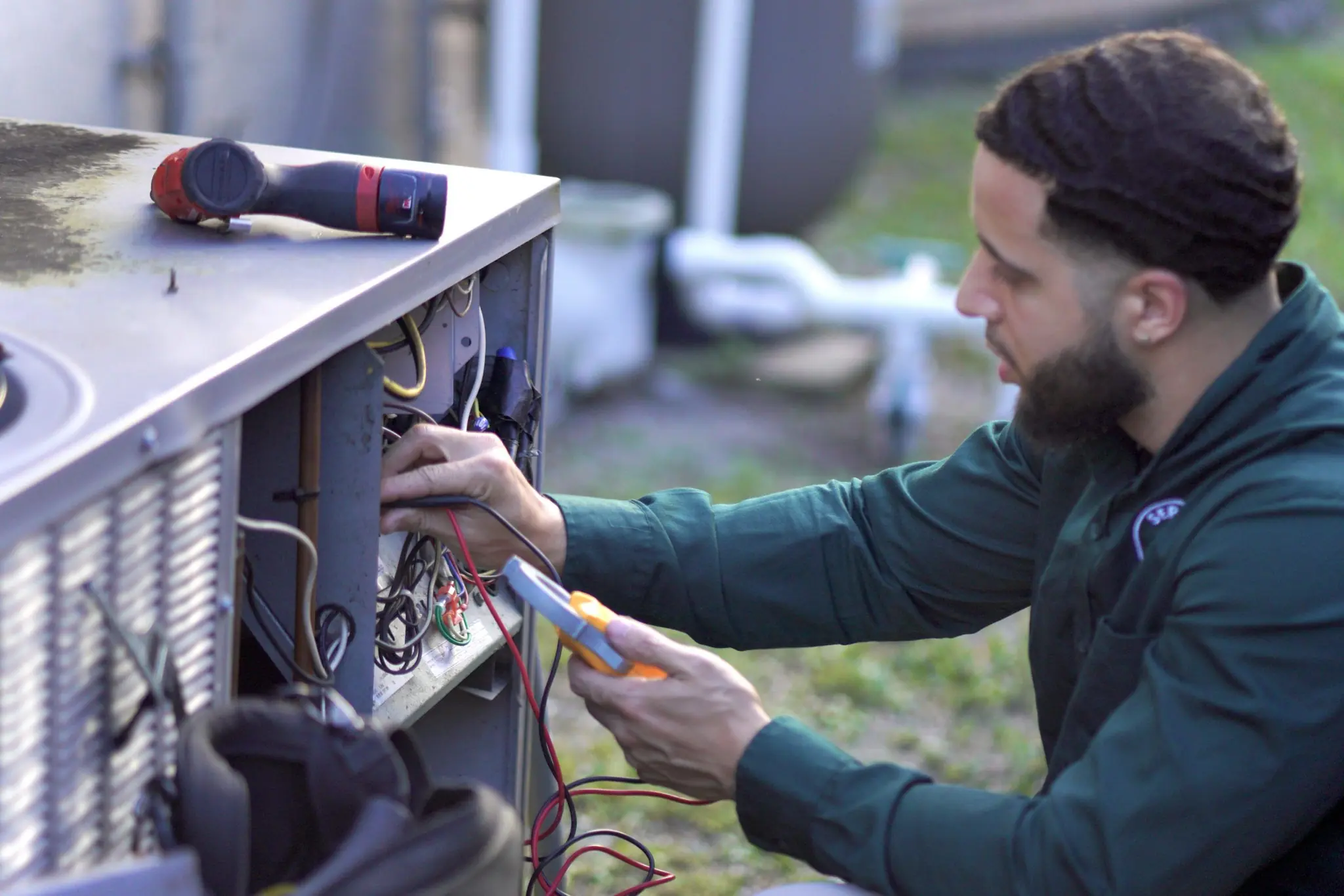
- Voltage and current on the compressor and fan motors, measured while they run and compared with the nameplate.
- Connections, tightened and checked for heat damage. ENERGY STAR warns that faulty electrical connections can make a system unsafe and shorten the life of major components.
The condensate drain
An air conditioner removes water from the air, and in South Florida that's a lot of water. If the drain line is blocked, a float switch shuts the system off before the pan overflows. It's a water-level safety device, and it's doing its job. The system then looks "dead" even though nothing electrical has failed. Checking the pan, the trap and the float switch is part of every no-cooling diagnosis here. The drain line guide explains why they clog, including the biological slime that builds up in drain lines here.
Putting it together
No single reading makes a diagnosis. These are examples of how readings combine, not rules:
- Warm air, low suction pressure, high superheat and oily residue at a joint fit the pattern of a refrigerant leak. The next step is confirming where it is.
- Warm air, a frozen indoor coil, a normal-looking charge and high static pressure fit the pattern of an airflow problem. Adding refrigerant would make things worse.
- An outdoor unit humming but not starting, with a capacitor well below its rating, points to a start failure. The capacitor gets replaced, and the compressor's current is checked once it runs to make sure nothing else is wrong.
The point of measuring everything, instead of stopping at the first bad part, is that one failure often causes another. A weak capacitor can be the result of a motor working too hard, and a frozen coil can be the result of a dirty filter. Fixing the first part without finding the second is how the same call happens twice.
What you should get from the visit
A good diagnosis ends with an explanation you can follow:
- What failed, and the reading or observation that shows it.
- Anything else that's wearing out, separated from what needs fixing now.
- The options, whether that's a repair, keeping an eye on something, or planning a replacement, with the practical pros and cons of each for your system.
Photos help, and so do the actual numbers. If a recommendation can't be connected to a measurement, it's fair to ask why. The decision is yours, and nobody should rush you into it.
The service call
Free service call with repair. Protection Plan members get a discounted diagnostic fee.
Before you call: what helps
Note what the system is doing and when it started, what the thermostat shows, whether a breaker tripped, and whether you see water or hear anything new. Check that the filter isn't clogged.
You can also text photos of the equipment's data plate, the thermostat or anything that looks wrong to our Text a Tech number, 561-599-1884. It helps the technician arrive prepared, though it doesn't replace measuring the system in person. The problem guides walk through the safe checks for each symptom.
Want a technician to take a look?
Schedule serviceThe readings, at a glance
What each measurement tells a technician, and why none of them is read on its own.
return vs. supply °F
Shows whether the indoor coil is removing heat. The right split depends on indoor humidity and airflow, so it's compared with a target, not a fixed number.
°F
Superheat is used on systems with a fixed metering device, subcooling on systems with an expansion valve. Together with pressures they show whether the refrigerant charge is right.
in. w.c.
The resistance the blower is pushing against. It's compared with the maximum on the air handler's rating plate; high readings mean restricted airflow.
amps
Measured under load and compared with the nameplate. Abnormal current points to a failing motor, compressor or capacitor.
µF vs. rating
A capacitor that has drifted below its rated value can stop a motor or compressor from starting in the heat.
flow / float switch
Confirms water is leaving the system and that the float switch isn't what's holding it off.
Targets vary by equipment, refrigerant and operating conditions. Technicians compare readings with the manufacturer's data for that system.
About this guide
- Written by
- Service Shield Air Conditioning
- Published
- Oct 2026
- Last updated
- Oct 2026
Sources
- DOE / PNNL Building America Solution Center: Heat Pump Quality Installation and Commissioning (superheat, subcooling, total external static pressure)
- DOE / PNNL Building America Solution Center: Traditional Split Heat Pumps (charging methods)
- ENERGY STAR: Maintenance Checklist
- ENERGY STAR: HVAC Quality Installation
- Lennox: Static Pressure in HVAC
- Goodman: Multi-speed air handler specification sheet (airflow vs. external static pressure; rating-plate limit)
- Carrier: AC Repair (verifying repairs with temperature splits, airflow and safety controls)
- HVAC School: 20° Delta T: A Lazy Rule of Thumb (training source)
- HVAC School: What Should My Subcooling Be? (training source)
- Florida Building Code, Mechanical, 8th Ed. (2023), Chapter 3: §307.2.3 secondary condensate protection (UpCodes)
Questions about AC diagnosis
Isn't the fault code on my unit the diagnosis?
It's a starting point. A fault code tells you which safety or sensor the control board noticed, not always why it happened. A low-pressure code, for example, can come from a refrigerant leak, a failed fan or an airflow problem. The readings behind the code are what identify the part to replace.
What's a normal temperature split for an AC?
There isn't one number that's right for every system. You'll often hear about 20°F between the return and supply air, but the right split depends on how humid the indoor air is and how much air is moving across the coil. A technician works out a target for your system's conditions and compares the measured split with it.
Related services and problems
Want the readings, not a guess?
Tell us what your system is doing. A diagnosis starts with measurements and ends with an explanation you can follow.
Florida license CAC1821225