The short answer
Sometimes repairing a system is the sensible decision, and sometimes replacing it is. Repair usually makes sense when the system is reasonably young, one part failed, and everything else measures healthy. Replacement starts to make sense when the system is older, the failure is a major component, the repairs are adding up, or the house has never been comfortable. Most decisions aren't close once the readings are in front of you. The hard ones are middle-aged systems with an expensive failure, and that's where the details below matter.
How we approach the decision
An AC failure rarely comes at a convenient time, and it can put a decision worth thousands of dollars in front of you that you weren't planning to make. That deserves an explanation, not a sales pitch in either direction.
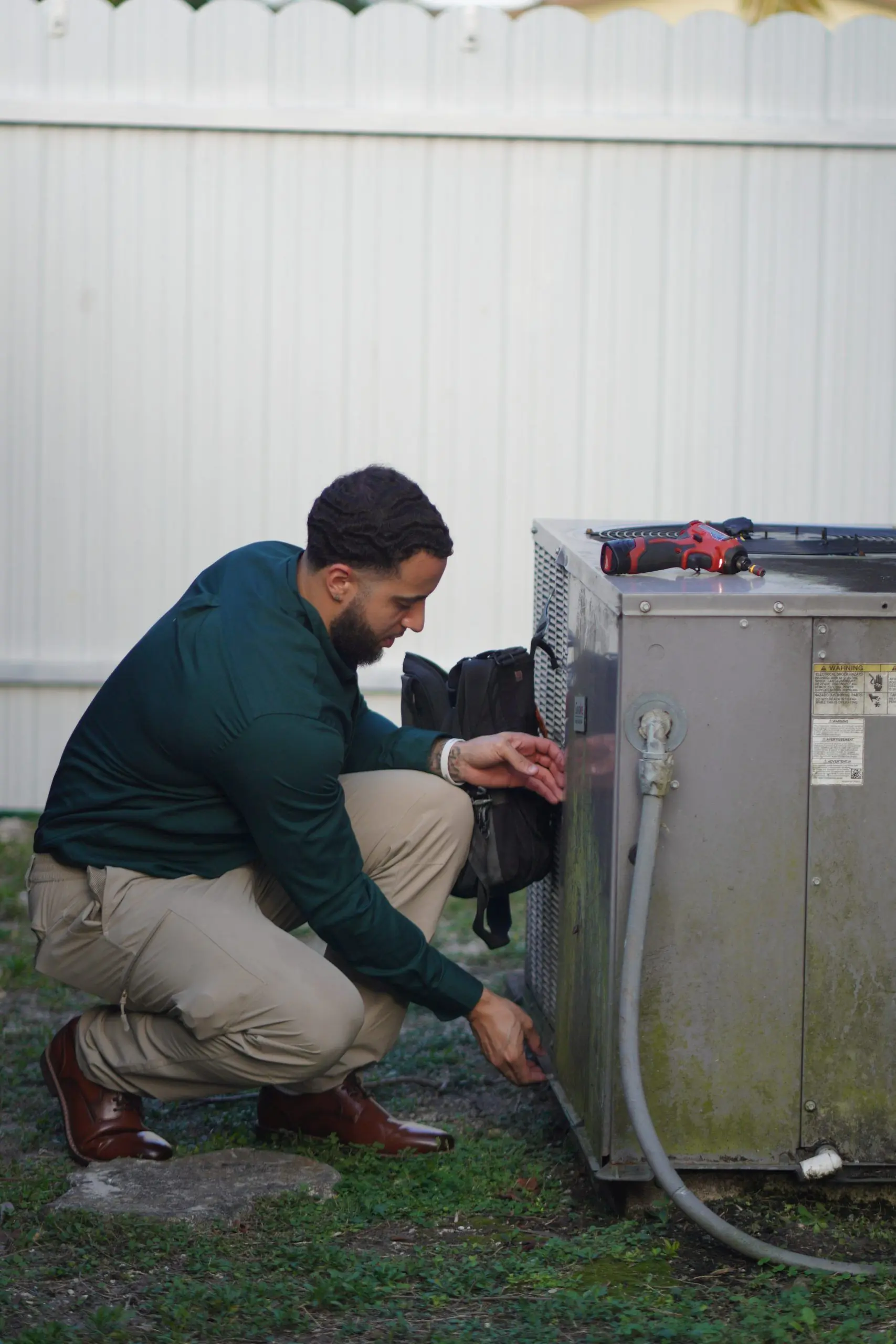
Our job is to diagnose the system, show you what we found, and lay out the paths that make sense for it: repair it, repair it and plan a replacement for later, or replace it now. For each one we explain the practical pros and cons, including what a repair buys you on a system of that age and what a replacement involves. Then you decide. We won't talk you into repairing equipment that's worn out, and we won't push a replacement on a system that has good years left in it.
If you'd like a rough sense of what a replacement involves before anyone visits, the AC replacement estimator gives you a nonbinding starting point. It isn't a quote. Final pricing depends on the equipment you choose and what we find at the house.
Start with what failed, and what didn't
A diagnosis should tell you two things: what failed, and the condition of everything else. A burned contactor or a weak capacitor on an otherwise healthy system is a routine repair at almost any age. A failed compressor, a leaking indoor coil or a third refrigerant leak is a different conversation, because the next failure is likely to be just as expensive.
Ask for the readings behind the recommendation, such as refrigerant charge, temperature split, static pressure and compressor current. A system with healthy numbers apart from the failed part is a better candidate for repair than one where several readings are drifting. The diagnostics guide explains what each reading means.
Age, and why South Florida shortens it
The U.S. Department of Energy's building research program puts the typical lifespan of HVAC equipment at 15 to 20 years, and major manufacturers give similar ranges for central air conditioners, with heat pumps often a little shorter. ENERGY STAR suggests considering replacement once a heat pump or air conditioner is more than 10 years old.
Those averages assume a normal workload. Here, a system runs long and hard year after year, and Trane notes that a Florida system may wear out before the average life expectancy. Near the coast, Carrier notes that salt spray corrodes outdoor coils faster than inland air. So a ten-year-old system in Broward has done more work than a ten-year-old system in a mild climate, and that belongs in the decision.
Age alone isn't a reason to replace a system that works well. It's a reason to think twice before putting a major repair into one that doesn't.
The refrigerant question
R-22 systems. U.S. production and import of R-22 ended on January 1, 2020. EPA says you can keep using an R-22 system for as long as it works, and it can still be repaired, but service relies on recovered, reclaimed and previously produced refrigerant. A refrigerant leak in an R-22 system is often the point where replacement deserves a serious look, because the equipment is old and the leak is likely to be the first of several. EPA also warns that "R-22a" is not an acceptable substitute. It's a flammable hydrocarbon blend.
R-410A systems. Most systems installed before 2025 that aren't old enough to use R-22 run on R-410A. EPA's rules don't restrict repairing them, and the agency expects R-410A to remain available for service. A newer R-410A system with a repairable problem is not a reason to replace on refrigerant grounds alone.
New systems. Since 2025, new systems use lower-global-warming refrigerants such as R-454B or R-32. Existing R-410A or R-22 equipment can't be converted to them, because they're approved only for equipment designed for them. The refrigerant guide covers the details.
Repair history and the next repair
Add up what the system has needed in the last two or three years, then think about what's likely next. One repair after years of trouble-free service says little. Three in two summers usually says the system is wearing out as a whole, and at that point the next repair is worth weighing against the cost of replacement rather than on its own.
Timing matters too. A failure in the middle of August leaves little room to compare options. If your system is old and showing signs, such as more frequent repairs, longer run times or a slow leak, planning a replacement in a cooler month gives you time to get a proper load calculation and choose equipment instead of taking whatever is available that week.
Comfort and humidity problems
If the house has never felt right, a like-for-like replacement will reproduce the problem. The usual signs are air that feels clammy even at a low thermostat setting, one room that's always warm, or a system that turns on and off every few minutes.
Oversizing is a common cause. ENERGY STAR explains that oversized units short-cycle, which reduces the water drained off the coil and can let moisture evaporate back into the air. UF/IFAS Extension puts it simply: an oversized air conditioner cools the house too quickly to remove moisture well, and the load has to be calculated, not estimated from square footage. Hot rooms are often a duct problem rather than an equipment problem. See room not cooling.
A replacement is the right time to fix those causes, with a load calculation instead of matching the old tonnage (see the sizing guide) and a look at the ductwork before new equipment is connected to it.
What a replacement should include
A replacement isn't just a box swap. It should include:
- A matched system. Indoor and outdoor equipment are rated as a pair, and ENERGY STAR has long advised replacing both at the same time. Florida's energy code requires matched systems on replacements. Replacing only the outdoor half of an old split system is a repair, not an upgrade. (See central air conditioners.)
- Sizing based on the house. Florida law states the Legislature's intent that replacement systems be installed using quality procedures, including equipment sizing analysis and duct inspection.
- Startup readings. Charge, airflow and temperature split, measured and recorded once the system runs.
A simple way to decide
- Get the diagnosis and the readings.
- Check the age and refrigerant on the data plate.
- Add up the last few years of repairs.
- Ask whether the house was comfortable before this failure.
- If two or more of these point toward replacement, get a replacement estimate before approving a major repair.
Most of the time the answer becomes clear at step three or four. If it doesn't, ask us to walk through both paths side by side before you decide.