
24/7 AC service

Indoor air quality · Air cleaners

Whole-home air cleaners and air scrubbers, explained plainly

An air cleaner in the duct system treats the air every time the blower runs. Whether it's worth adding depends on what you want gone, and on what the product can show about how it was tested.

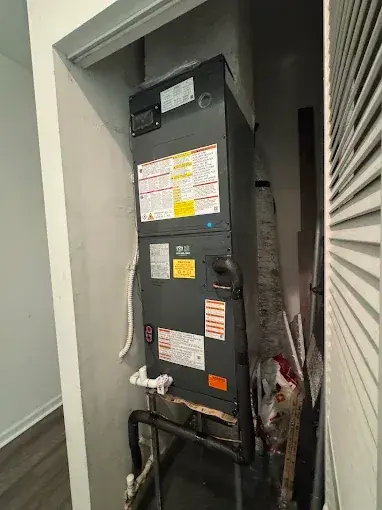
New air handler in a closet, with its refrigerant and drain connections at the base

Whole-home air cleaners mount in the return duct or at the air handler, so all the air the blower moves passes through them on its way back to the coil. That's the advantage over a portable unit in one room. When the system runs, the whole house is being treated.

The category is broad, and the products in it work in very different ways. Some are simply bigger, better filters. Some use an electrical charge to collect particles. Some use ultraviolet light, catalysts or charged ions to treat the air and the surfaces it touches. Carbon media go after odors and gases rather than particles. A comparison only makes sense type by type.

Air scrubbers

In home HVAC, "air scrubber" usually means a unit installed in the supply or return duct that shines a UV lamp on a surface coated with a catalyst, sometimes paired with an ionizer. As air passes through, the unit is designed to break down odor-causing gases and treat surfaces the air reaches. It isn't a filter. It does little for dust, and it does nothing for humidity, so it works alongside a good filter rather than in place of one.

An air scrubber makes the most sense when there is a specific target, such as lingering cooking or pet odors, in a house where moisture and the coil have already been checked. Before choosing one, ask for independent test data, confirm it is validated for zero ozone, and know when the lamp and catalyst cell need replacing. A lamp and cell past their service life keep running without doing much.

Particles, odors and gases

For particles like dust, pollen, pet dander and smoke, the most dependable upgrade is usually better filtration: a deep media cabinet that holds a high-rated filter without choking airflow. It's simple, the evidence behind it is strong, and the upkeep is a filter change.

For odors, carbon is the plain option. It adsorbs gases until it fills up, and then it gets replaced.

Products that claim to treat germs or chemicals in the air deserve more questions. Ask what was tested, by whom and at what airflow, and whether the device produces ozone. EPA advises against adding ozone to indoor air, and some ionizers and older electronic designs create it.

Fix the cause first

A lot of "air quality" complaints have causes an air cleaner won't touch. Dust that comes back days after cleaning can point to leaking return ducts pulling in attic air. A musty smell usually traces back to moisture: a dirty coil, a drain pan that doesn't empty, or a house that stays too humid. We check those first. Then, if an air cleaner or air scrubber would add something, we'll say which type and why.

The main types

Focus on one option
TypeHow it worksGood atWatch for
Media air cleanerA deep pleated filter in a cabinet at the air handler or returnDust, pollen, pet dander and, at higher ratings, much of the fine particle loadHas to be sized for the system's airflow, and the media is replaced on schedule
Electronic air cleanerCharges particles and collects them on metal platesFine particles, with little resistance to airflowCollector cells need regular washing, and some designs produce ozone
In-duct air scrubberA UV lamp shining on a catalyst-coated surface inside the duct, sometimes with an ionizerDesigned to treat odors and gases in the air stream and on surfaces the air reachesResults vary by product and by house. Ask for independent test data and zero-ozone validation
Ionizing devicesRelease charged ions into the air stream so particles clump and settleVaries widely by productClaims often run ahead of independent evidence, and some produce ozone
Activated carbonAdsorbs odor and gas molecules onto the carbon's surfaceCooking, pet and stale odorsFills up over time and does little for particles on its own

How it works

Media air cleaner
A deep pleated filter in a cabinet at the air handler or return
Electronic air cleaner
Charges particles and collects them on metal plates
In-duct air scrubber
A UV lamp shining on a catalyst-coated surface inside the duct, sometimes with an ionizer
Ionizing devices
Release charged ions into the air stream so particles clump and settle
Activated carbon
Adsorbs odor and gas molecules onto the carbon's surface

Good at

Media air cleaner
Dust, pollen, pet dander and, at higher ratings, much of the fine particle load
Electronic air cleaner
Fine particles, with little resistance to airflow
In-duct air scrubber
Designed to treat odors and gases in the air stream and on surfaces the air reaches
Ionizing devices
Varies widely by product
Activated carbon
Cooking, pet and stale odors

Watch for

Media air cleaner
Has to be sized for the system's airflow, and the media is replaced on schedule
Electronic air cleaner
Collector cells need regular washing, and some designs produce ozone
In-duct air scrubber
Results vary by product and by house. Ask for independent test data and zero-ozone validation
Ionizing devices
Claims often run ahead of independent evidence, and some produce ozone
Activated carbon
Fills up over time and does little for particles on its own

General characteristics of each technology. Specific products differ, so ask for their test data.

What any whole-home air cleaner can and can't do

What it does

  • Treat the air the system moves through it, in every room the ducts serve
  • Capture more airborne particles when it is, or works with, a properly sized media filter
  • Cut down some odors, if it carries enough carbon or is designed for gases

What it doesn’t do

  • Clean air that isn't moving, because the blower has to run for it to work
  • Fix the moisture problems behind most musty smells
  • Remove dust that has already settled on floors and furniture

Questions to ask before buying one

  1. What does it remove, and where's the independent test data?

    A product sheet should say which pollutants it was tested against, by whom, and at what airflow. A test in a sealed chamber is not the same as a duct system at full blower speed.

  2. Does it produce ozone?

    EPA advises against devices that generate ozone indoors. Look for validation of zero ozone emissions, such as UL 2998.

  3. What does it do to airflow?

    Anything in the air path adds resistance. A static pressure reading before and after shows whether the system can handle it.

  4. What's the upkeep?

    Media, cells, lamps and carbon all need replacing or cleaning on a schedule. Know the interval and the cost of the parts before you commit.

  5. Does the problem actually call for it?

    Dust everywhere can mean leaky return ducts. A musty smell usually means moisture. Fixing the cause often matters more than adding a device.

Air cleaner questions

Will an air purifier get rid of a musty smell?

Usually not on its own. Musty smells in South Florida homes mostly come from moisture: a dirty coil, a backed-up drain pan, or humidity that stays too high. Fixing the moisture is the real cure, and carbon media can help with odors once that's done.

Are ionizers and ozone-producing air cleaners safe?

EPA advises against adding ozone to indoor air, and some ionizers and older electronic air cleaners produce it. If you're considering a device, ask for validation that it emits no ozone, such as UL 2998, and for independent test data on what it removes.

Not sure what's in the air?

Start with what you're noticing, whether that's dust, odors or a stuffy feel, and we'll look at the system before we talk about equipment.

Florida license CAC1821225

CallText a TechSchedule