
Resistance to airflow
- 1-inch filter, MERV 8
- Low
- 1-inch filter, MERV 11–13
- Higher, and it can restrict systems with small returns
- 4–5 inch media cabinet
- Low for its rating, thanks to far more surface area
Indoor air quality · Filtration
The filter is the simplest air quality upgrade in the house, and the one most often done wrong. A better filter only helps if the system can still breathe through it.
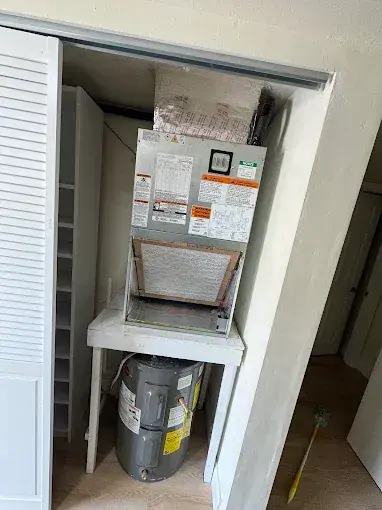
Every central air conditioning system has a filter, usually behind the return grille or in a slot at the air handler. Its first job is protecting the equipment. Dust that gets past it coats the evaporator coil, which cuts cooling and gives growth on the wet coil something to hold onto. Its second job is cleaning the air in the house, and how well it does that depends on its rating.
The filter problems we run into most aren't about the rating at all. A filter a size too small, sitting loose in the rack. A slot at the air handler with no cover, pulling in air from the closet or the attic. A return grille with gaps around the frame. In each case some of the air goes around the filter instead of through it, and the coil collects what the filter should have caught. A higher-rated filter doesn't help until that air path is closed.
The other common one is a filter that's too dense for the system. A homeowner buys the best filter on the shelf, puts it in a 1-inch slot behind a small return, and the system starts to struggle.
Filters are rated by MERV, a scale defined by ASHRAE. Higher numbers catch a larger share of smaller particles. A basic fiberglass filter stops large debris and little else. A MERV 13 filter catches a large share of fine particles, which is why EPA suggests it for homes when the system can handle it.
That last part is the catch. A higher-rated filter is denser, and a thin 1-inch filter has very little surface area. Put a dense 1-inch filter in a system with a small return and the blower struggles. Airflow drops, the coil runs colder, efficiency falls, and in bad cases the coil freezes. The house gets less filtration, not more, because the system moves less air.
Giving up on better filtration isn't the answer. Giving the filter more surface area is. A media cabinet holds a 4- or 5-inch pleated filter with many times the material of a 1-inch filter, so it can carry a higher rating with less resistance, and it typically lasts longer between changes. Where there's no room for a cabinet, a larger or second return grille can do some of the same work.
Whatever the setup, measure before changing it. A static pressure reading across the filter and the system shows how much resistance the equipment is already fighting, which decides how high a rating it can carry. And check the filter more often than the label suggests. In a Broward summer the system runs most of the day, and filters load up faster than they do in milder climates.
If the goal is less dust and fewer airborne particles, filtration is usually the most dependable first step. If the concern is odors or a musty smell, look at humidity and the coil first, because filters don't remove gases.
MERV ratings are defined by ASHRAE Standard 52.2. Higher numbers catch a larger share of smaller particles.
| Setup | Resistance to airflow | How often to check | Notes |
|---|---|---|---|
| 1-inch filter, MERV 8 | Low | Monthly in summer, and change it when it's visibly loaded | A sensible default for most systems |
| 1-inch filter, MERV 11–13 | Higher, and it can restrict systems with small returns | Monthly, because these load up faster | Measure static pressure before committing to one |
| 4–5 inch media cabinet | Low for its rating, thanks to far more surface area | Typically every few months, following the media's rating | Needs space at the return or air handler and a well-sealed cabinet |
in. w.c.
A manometer reading on each side of the filter shows how hard it is working. A large drop means the filter is choking airflow.
in. w.c.
Compared with the blower's rating. High readings mean the blower is fighting the filter and the ductwork together.
°F supply vs return
Too little airflow drives the coil colder, and in bad cases it freezes. An unusually large split is a clue.
These readings decide how high a rating the system can carry.
Only if the system can move enough air through it. A dense, high-MERV 1-inch filter can restrict airflow, which lowers efficiency and can freeze the coil. A deeper filter cabinet lets you use a higher rating with less resistance; a static pressure reading tells you what your system can handle.
Check a 1-inch filter monthly during the cooling season and change it when it's visibly loaded. Systems here run most of the day, so filters fill faster than the package suggests. Deep media filters typically last several months, so follow their rating.
A static pressure reading tells us what your system can handle before anything is changed.
Florida license CAC1821225