
24/7 AC service

Ductwork · Repair

Duct repair: fixing the runs that leak, sag or come apart

One warm bedroom, a whistle at a register, a damp spot on the ceiling. Most duct problems come down to one failed run or connection, and they can be fixed without replacing the whole system.

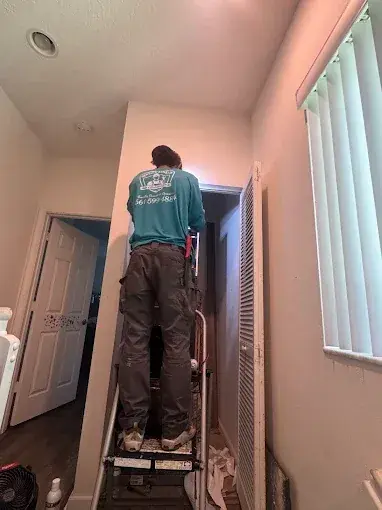
Service Shield technician on a ladder working at the top of an air handler closet

Most duct problems don't announce themselves as duct problems. They show up as a room that won't cool while the rest of the house is fine, weak airflow from one or two registers, a system that seems to run longer than it used to, or a damp spot on the ceiling under a run. In a typical Broward home the cause is in the attic, in a part of the system nobody has looked at since it was installed.

When the problem is limited to a run or a connection, it can be repaired on its own. The common repairs are:

  • A run that has pulled off its collar. Flex duct is held on its fittings by a strap and a seal. Heat, a careless step or a run installed under tension can work it loose, and from then on that room's air goes into the attic instead.
  • A crushed or torn section. Storage boxes, foot traffic and other trades working in the attic flatten flex runs. The outer jacket may look fine while the inner liner has collapsed.
  • A kinked or sagging run. Flex needs gentle bends and support along its length. A sharp bend at a takeoff, or a long run hanging between supports, restricts air the same way a pinched hose restricts water.
  • A sweating boot or register. The boot is the fitting behind each ceiling register. When it pulls away from the drywall or loses its insulation, humid attic air reaches the cold metal, and the vent drips or the ceiling around it stains.
  • Leaking joints. Connections at collars, takeoffs and plenums lose their seal over time. On the supply side that wastes cooling. On the return side it pulls hot, humid attic air into the system.

Repair, or something bigger?

A repair makes sense when the rest of the system is in good shape. If the inspection finds the same failures across many runs, such as brittle jackets, connections letting go and insulation breaking down, then duct replacement is usually the better value, and fixing one run at a time will keep costing money. If the problem is a room that was never comfortable, even when the ducts were new, the cause may be the layout itself. That is an airflow and duct design question rather than a repair.

We'll tell you which situation you're in and show you what we saw. The choice between a repair and a bigger fix is yours.

What a repair doesn't fix

Repairing a damaged run restores the airflow that run was designed to deliver. It can't make an undersized run carry more air, and it won't fix a system that doesn't have enough return. Water on the floor under the air handler is usually a drain problem rather than a duct problem; see AC leaking water. And if the coil is icing over, low airflow is one possible cause among several covered under frozen coils.

What a failed run does to the airflow

Pick a condition to see where the air goes, what you would notice, and how hard the blower works.

Animated diagram of air moving from the air handler through attic ductwork to two rooms and backATTICROOM AROOM BAIRHANDLER
Show a duct condition

Crushed or kinked flex duct

A run pinched under attic storage or bent sharply at a takeoff delivers a fraction of its air. The rest of the house is fine, and one room never catches up.

When one room won't cool

Blower effort

Normal

What you notice

  • One room warmer than the rest
  • Weak airflow at a single register

A run pulled off its collar

Cooled air pours into the attic instead of the room. The room stays warm, the attic gets cold and damp, and the system runs longer to make up for it.

Blower effort

Lower than it should be

What you notice

  • A room with almost no airflow
  • Longer run times and higher bills

A healthy duct system

Supply air reaches every room through sealed, supported runs, and enough air returns to the air handler to keep the blower in its comfortable range.

How airflow gets measured

Blower effort

Normal

What you notice

  • Rooms within a few degrees of each other
  • Steady airflow at every register
  • A quiet return grille

Where duct repairs happen

The same five places account for most of what goes wrong.

How a ducted AC system moves airSchematic of a house cross-section: the air handler pushes cooled air up into a supply plenum, through a trunk line and flexible duct runs in the attic to ceiling registers in each room. Air returns through a return grille and return duct back to the air handler.ATTICAIRHANDLER12345
Parts of the diagram

Loose or leaking connections where the plenums meet the air handler pull in closet or attic air and push out conditioned air.

A rusted, sweating or poorly sealed plenum affects every run at once. Some can be repaired; others need replacing.

More on supply plenum

The fittings where runs leave the trunk are where flex gets kinked, pulled loose or left unsealed.

Crushed, torn or sagging sections choke the airflow to one room. At the other end, a boot that has pulled away from the ceiling lets attic air in around the register.

A leaking return duct pulls hot, humid attic air straight into the system.

More on return path

Repairs we handle

  • Reconnecting separated runs

    Runs that have slipped off their collars are refitted, mechanically fastened and sealed.

  • Replacing damaged sections

    Crushed, torn or collapsed lengths of flex are cut out and replaced with new duct of the right size.

  • Re-supporting sagging runs

    Runs lying on joists or hanging in bellies are strapped and supported along their length.

  • Boots and registers

    Boots that have pulled away from the ceiling, lost their insulation or rusted are refastened, insulated or replaced. That is often what stops a vent from sweating.

  • Leaking connections

    Joints at collars, takeoffs and plenums that have let go are refastened and sealed as part of the repair.

How a repair visit works

  1. Start with the symptom

    Which rooms, since when, and whether anything changed in the attic, such as new storage, other trades working up there or a recent storm.

  2. Trace and measure

    The runs to the affected rooms are traced from the plenum to the register, and airflow or temperature at the register is checked.

  3. Show you what failed

    You see what we found, with photos from the attic when they help, and what the repair involves before the work starts.

  4. Repair what failed

    Reconnect, replace or re-support the damaged run and fasten and seal the connections it depends on.

  5. Check it again

    The same register is measured after the repair so the difference is visible.

Repairs keep adding up?

When the failures are spread across the attic, replacing the ductwork can cost less over time than fixing one run after another. Answer a few questions to see a rough range for repair or replacement. It's not a quote.

The on-site duct evaluation is free.

Duct repair questions

Why is one room warmer than the rest of the house?

The most common reasons are in the ductwork serving that room: a run that has come off its fitting, a crushed or kinked section, or a run that is too long or too small for the room. Sun exposure and a closed door with no way for air to return also play a part. Measuring the airflow and temperature at that room's register usually points to the cause.

Can I fix a loose duct with tape?

Tape alone rarely holds for long in a South Florida attic. The heat dries out the adhesive and the joint lets go again. A lasting repair refits the duct on its collar, fastens it mechanically and seals it. The attic itself is also a hazard in summer, and stepping between ceiling joists can put a foot through the ceiling, so this is a job best left to a technician.

One room won't cool?

Tell us which room and when it started. That narrows the search before anyone climbs into the attic.

Florida license CAC1821225

Text a TechSchedule