
Guide · Maintenance
What AC maintenance should include in South Florida
What AC maintenance should cover in South Florida, where systems run most of the year, from the drain and electrical parts to your part between visits.

Key takeaways
- South Florida systems run long hours in humid air, so they wear faster and send water down the drain nearly all year. Maintenance here is built around that.
- A real visit tests and measures: electrical parts including capacitors and contactors, refrigerant pressures, the temperature split, the thermostat and the whole condensate system.
- Drain lines need the most routine attention. Slime builds up in a line that never dries, and a bacterial biofilm called Zoogloea is one important part of it.
- Attic air handlers and condensate pumps add their own risks: more heat on the parts, and a leak that ends up in a ceiling.
- Between visits, check the filter monthly, keep the outdoor unit clear, and leave anything electrical or refrigerant-related to a technician.
The short answer
A maintenance visit should be a set of tests and cleanings with readings behind them, not a quick look. In South Florida the work leans toward what this climate wears out first: the condensate drain, the electrical parts in the outdoor unit, and air handlers that sit in hot attics and closets. Manufacturers such as Carrier list annual dealer maintenance in their owner's manuals, and ENERGY STAR recommends a check-up before the cooling season. Here, the cooling season is most of the year, so the useful question is less "when" than "what actually gets checked."
What South Florida does to an air conditioner
Long hours
A Broward system can run most of the day through the summer and still put in plenty of hours in the winter. Every one of those hours is wear on capacitors, contactors, fan motors and the compressor. Trane notes that an AC run long and hard every year in Florida may wear out before its average life expectancy, which matches what we see in the field.
Humidity and constant condensate
The indoor coil pulls water out of the air for every hour it runs. On a humid day that's gallons, and it never really stops. The drain pan, the trap and the line stay wet nearly all year, which matters for everything below.
Drain buildup and biological slime
A drain line that never dries grows slime. Part of it is a bacterial biofilm, and Zoogloea is one of the bacteria that forms it. It mixes with algae, mold and dust that got past the filter, and it builds slowly until water backs up into the pan. Then the float switch shuts the system off, or the pan overflows. Drain clogs are among the most common calls we run here. The drain line guide explains Zoogloea and the other causes, including slope and trap problems. See also AC not draining.
Electrical wear
Capacitors weaken in the heat of the outdoor cabinet, and contactors pit and burn from switching the outdoor unit on and off all season. A weak capacitor is one of the most common reasons an outdoor unit won't start on a hot afternoon. Both parts usually test poorly before they fail outright, which is why they're tested on every visit instead of waiting for a no-cooling call.
Attic equipment
Plenty of air handlers here sit in attics, where summer heat is far beyond what the outdoor air reaches. That heat is hard on motors and electrical parts. A drain problem in an attic ends up in a ceiling, and nobody sees the unit between visits. Attic systems need secondary protection that works, either a pan with its own drain or a float switch, and a drain that can actually be reached for flushing.
Condensate pumps
Where an air handler can't drain by gravity, a small pump lifts the water out. Pumps wear out, and their tubing and check valves gum up with the same slime as the drain line. In attics, Florida's code requires the equipment to shut off if the pump fails. If your system has one, it's checked with the rest of the condensate system.
Salt near the coast
Outdoor coils and copper joints corrode faster near the ocean and the Intracoastal. Carrier suggests that coastal owners wash the outdoor coil and exposed surfaces about every three months.
What a maintenance visit checks
This is the checklist used on Service Shield Protection Plan visits, and both visits each year cover all of it:
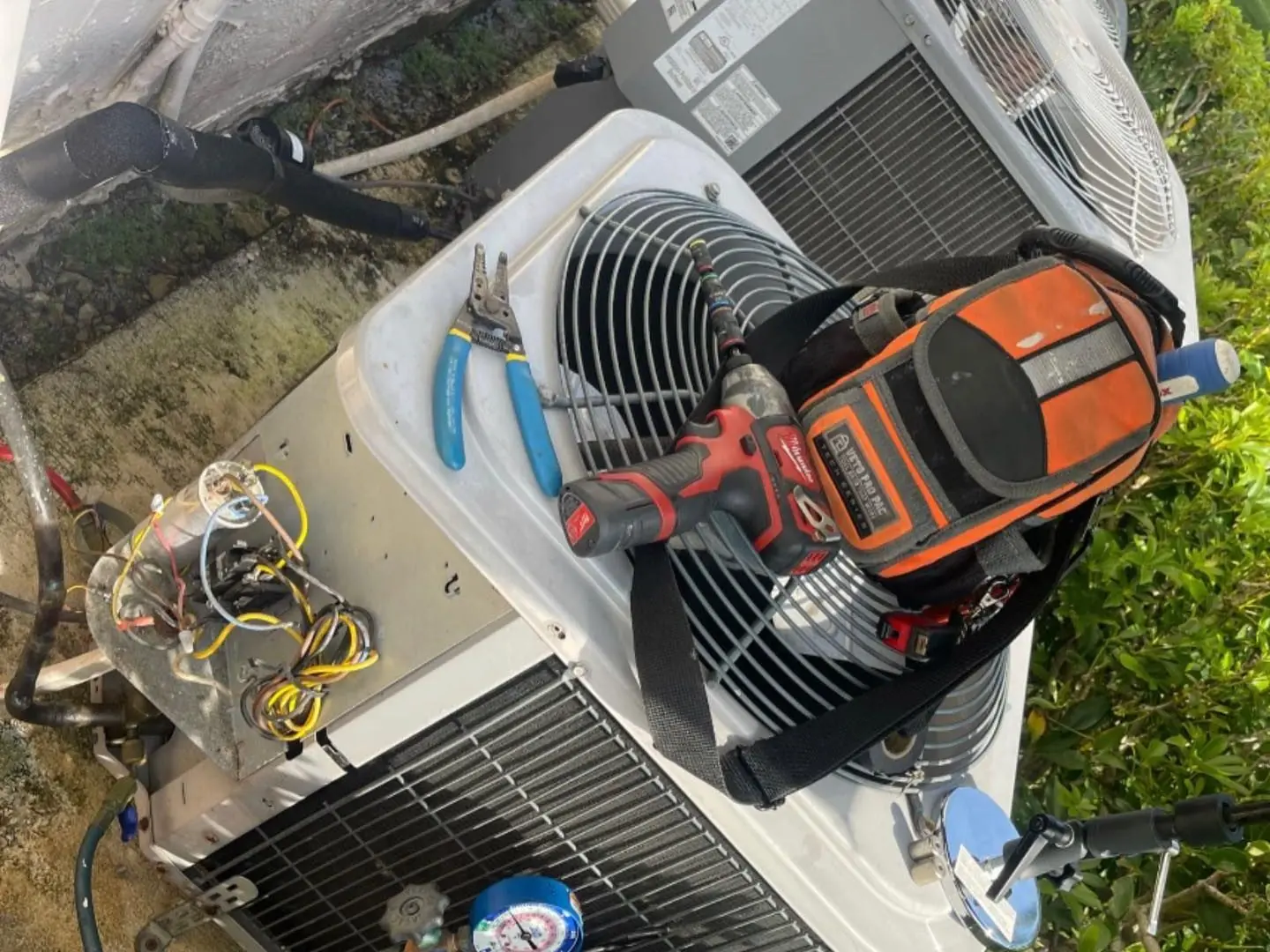
- Full system inspection, indoor and outdoor. The air handler, coil, blower, cabinet and refrigerant lines inside, and the outdoor unit, its coil and its pad or stand outside.
- Electrical component testing. Voltage and current on the motors and compressor, measured while they run and compared with the nameplate, plus connections checked for heat damage. ENERGY STAR warns that faulty connections can make a system unsafe and shorten the life of major components.
- Capacitor and contactor testing. Capacitors are measured against the rating printed on them. The contactor is checked for pitted or burned contacts.
- Refrigerant pressure check. Pressures are read on the running system and compared with what the equipment should show in that day's conditions. A low charge means a leak, and the right response is finding it, not routinely adding refrigerant.
- Temperature split testing. The difference between the air going into the indoor coil and the air coming out. A shrinking split is often the first sign of a dirty coil, a low charge or weak airflow.
- Thermostat check and calibration, so the system answers to the right temperature and cycles properly.
- Drain line flush and drain treatment, to clear the buildup and slow new growth.
- Condensate system inspection, including the pan and float switch. The pan is checked for standing water, rust and cracks, and the float switch, secondary pan and any condensate pump are checked too.
- System performance and safety checks, confirming the system starts, runs and shuts off the way it should.
ENERGY STAR's own maintenance checklist covers the same core ground: the thermostat, electrical connections, refrigerant charge, the condensate drain and the controls. Anything the visit turns up that needs more work, such as a dirty coil or a part that's wearing out, is shown to you and explained before anything else is done.
Signs it needs attention before the next visit
Call before the scheduled visit if you notice:
- warmer air from the vents, or a system that runs much longer than usual (see AC blowing warm air);
- ice on the refrigerant lines or the indoor coil (see frozen coil);
- water around the air handler or in the secondary pan, or no drip at the drain outlet on a humid day;
- a new noise, a burning smell, or a breaker that trips.
How often
ENERGY STAR's baseline is a professional check-up every year before the cooling season, and manufacturers' owner's manuals call for annual maintenance too. For systems that rarely get a break, that's the minimum. Attic units, homes near the coast and drains with a history of clogging all benefit from more frequent attention. That's why the Protection Plan includes 2 visits a year with the full checklist at each one. The AC maintenance page explains a single visit, if you'd rather book one on its own.
Your part between visits
Safe, simple habits that help a South Florida system between visits. Turn the system off at the thermostat before touching anything at the equipment.
All done.
Anything that looked wrong along the way is worth a technician’s visit.
Membership
Service Shield Protection Plan
- Two full maintenance visits a year, the same complete checklist each time
- Discounted diagnostic fee for members
- Up to 15% off repairs
$299 per year
See what the plan includesAbout this guide
- Written by
- Service Shield Air Conditioning
- Published
- Oct 2026
- Last updated
- Oct 2026
Sources
- ENERGY STAR: Maintenance Checklist
- ENERGY STAR: Heat & Cool Efficiently (filter guidance)
- Carrier: R-454B split AC owner's manual OG-ACR454GEN-02 (annual dealer maintenance; coastal care)
- Trane: HVAC Maintenance Tips & Checklist
- Trane: AC Coil Cleaning and Maintenance Tips
- Trane: AC Condensate Drain Line Clogged?
- Trane: How Long Do AC Units Last? (Florida wear note)
- Lennox: Air Conditioner Maintenance Tips
- Lennox: What To Do When You Have a Clogged AC Drain Line
- Florida Building Code, Mechanical, 8th Ed. (2023), Chapter 3: §307 condensate disposal (UpCodes)
- FSEC (University of Central Florida): Mold Growth (thermostat fan setting)
- DOE: Energy Saver 101, Home Cooling infographic (filter savings)
Maintenance questions
How often should I change my AC filter?
Check it every month and change it whenever it looks dirty. ENERGY STAR's minimum is every three months. Homes with pets, dust or construction nearby usually need more frequent changes, and if a filter lists its own schedule, follow it.
How often should an AC be serviced in South Florida?
Twice a year makes sense for most South Florida homes. The cooling season here covers most of the year and drain lines and coils work hard, so the once-a-year check-up ENERGY STAR recommends as a minimum often isn't enough. Filters, the drain and the outdoor coil also need attention between visits.
Want maintenance on a schedule?
The Service Shield Protection Plan includes two maintenance visits a year, with the full checklist at both. Prefer a single visit? Request one any time.
Florida license CAC1821225