
Replacing an AC in a Florida Condo
How replacing a condo air conditioner in Broward differs, from association approval and closet air handlers to rooftop condensers, drains and access.
Key takeaways
- Start with your condo documents and your association. They say who is responsible for the equipment and what approval a replacement needs.
- Closet air handlers have to fit the space and still leave room for the filter, the coil and a drain system that protects the unit below.
- Condensers on roofs and catwalks need hurricane-zone anchoring, and roof-mounted equipment has its own permit paperwork in Broward.
- The indoor and outdoor equipment must be a matched pair. With the refrigerant transition, replacing only one half is often not possible or not wise.
The short answer
Replacing an air conditioner in a condo is the same job as in a house. The indoor and outdoor equipment are matched, sized to the space, and installed to code and inspected. A condo adds two layers on top of that, your association's rules and the building itself, and most of the surprises in condo replacements come from those two. Start there.
Start with the documents
Florida's condominium law says there can be no "material alteration or substantial additions to the common elements" except in the manner the declaration provides. Where your air conditioning equipment sits (inside your unit, in a closet off a shared hallway, on the roof or on a catwalk) can change which rules apply to replacing it.
Before you get quotes, find out from your declaration, rules or property manager:
- who owns and is responsible for the air conditioning equipment that serves your unit;
- where outdoor equipment may be placed, and whether a new unit must match a size, location or appearance;
- what the association needs before work starts, such as an application, an approval letter or proof of the contractor's insurance;
- when work is allowed, how the roof is accessed, and whether elevators need to be reserved and protected.
Some city change-out checklists ask for an association approval letter where one is required, so it's worth having it before the permit is filed.
Closet air handlers: tight spaces and drains that matter
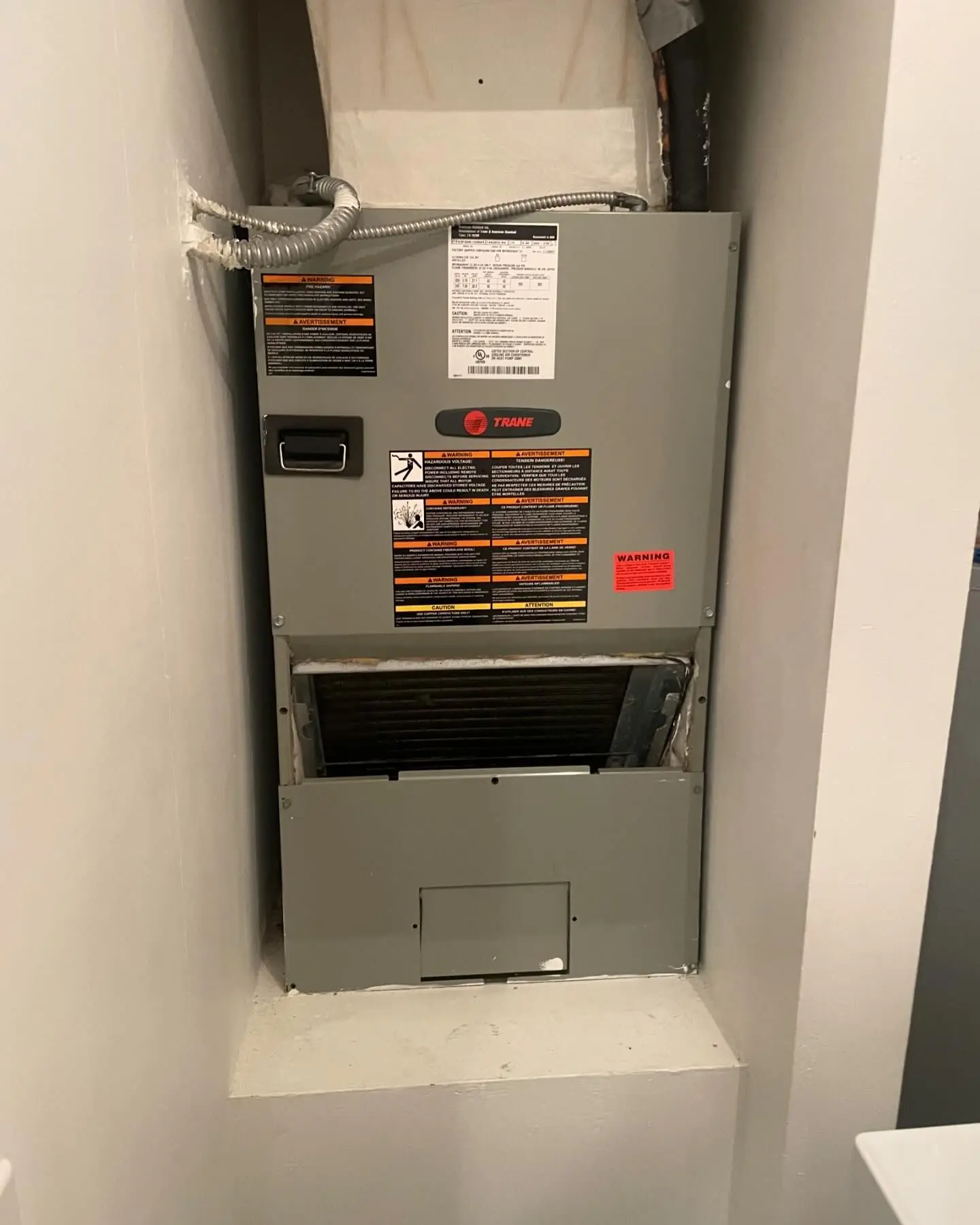
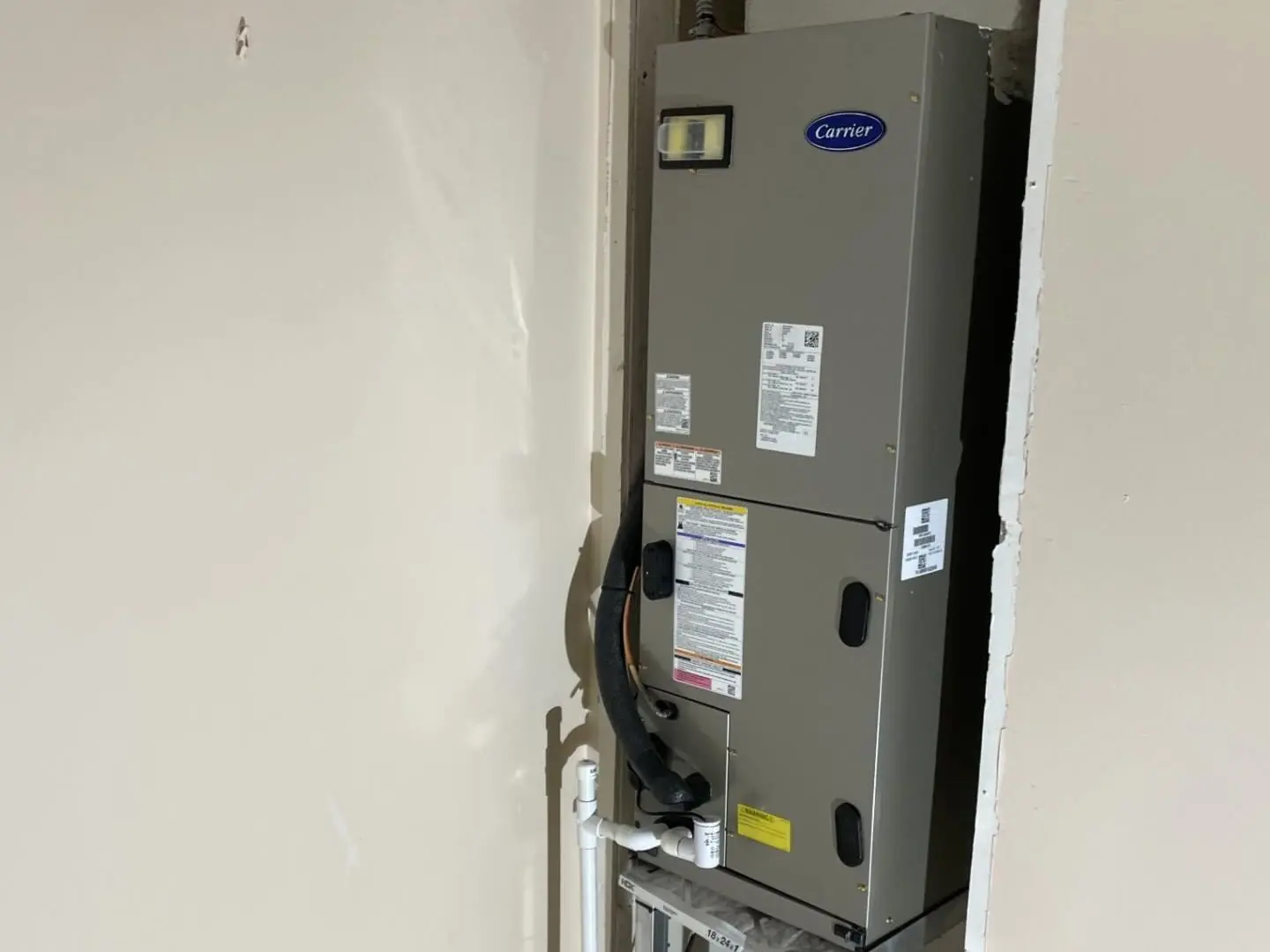
In most Broward condos the indoor half of the system lives in a closet inside the unit. That's the air handler, with its blower, evaporator coil and drain pan, and the closet shapes the replacement:
- It has to fit. The new air handler has to come through the door, sit on its stand or platform and still leave room to change the filter and reach the coil and drain for service.
- The drain protects your neighbors. Florida's mechanical code requires extra overflow protection wherever overflow from the primary drain could damage building components. That means an auxiliary pan with its own drain, an overflow drain, or a water-level switch that shuts the system off. In a condo, the building component at risk is often the ceiling of the unit below. See AC leaking water and AC not draining.
- The drain route may be long. Condensate lines can run through walls and shared chases before they reach an outlet. A replacement is the time to make sure the line is sloped, cleanable and protected.
Matching the two halves
A split system is rated as a pair, and Florida's energy code requires replacement systems to be matched, meaning the indoor and outdoor equipment have to be a certified combination. The refrigerant transition makes that more important than it used to be.
New residential systems now use lower-GWP refrigerants such as R-454B or R-32. Federal rules list these refrigerants only for new equipment designed for them, not for converting existing R-410A or R-22 equipment. Repairing an existing system isn't restricted, and replacing a failed outdoor unit with a matching one can still be an option in some cases. When the system is old, though, replacing both halves together is often the practical choice in a condo. EPA has said existing refrigerant tubing can be inspected and reused if it's suitable, which matters in a building where the line set runs through walls or up to a roof.
For the details, see the R-454B guide, and air handler replacement.
Condensers on roofs, catwalks and balconies
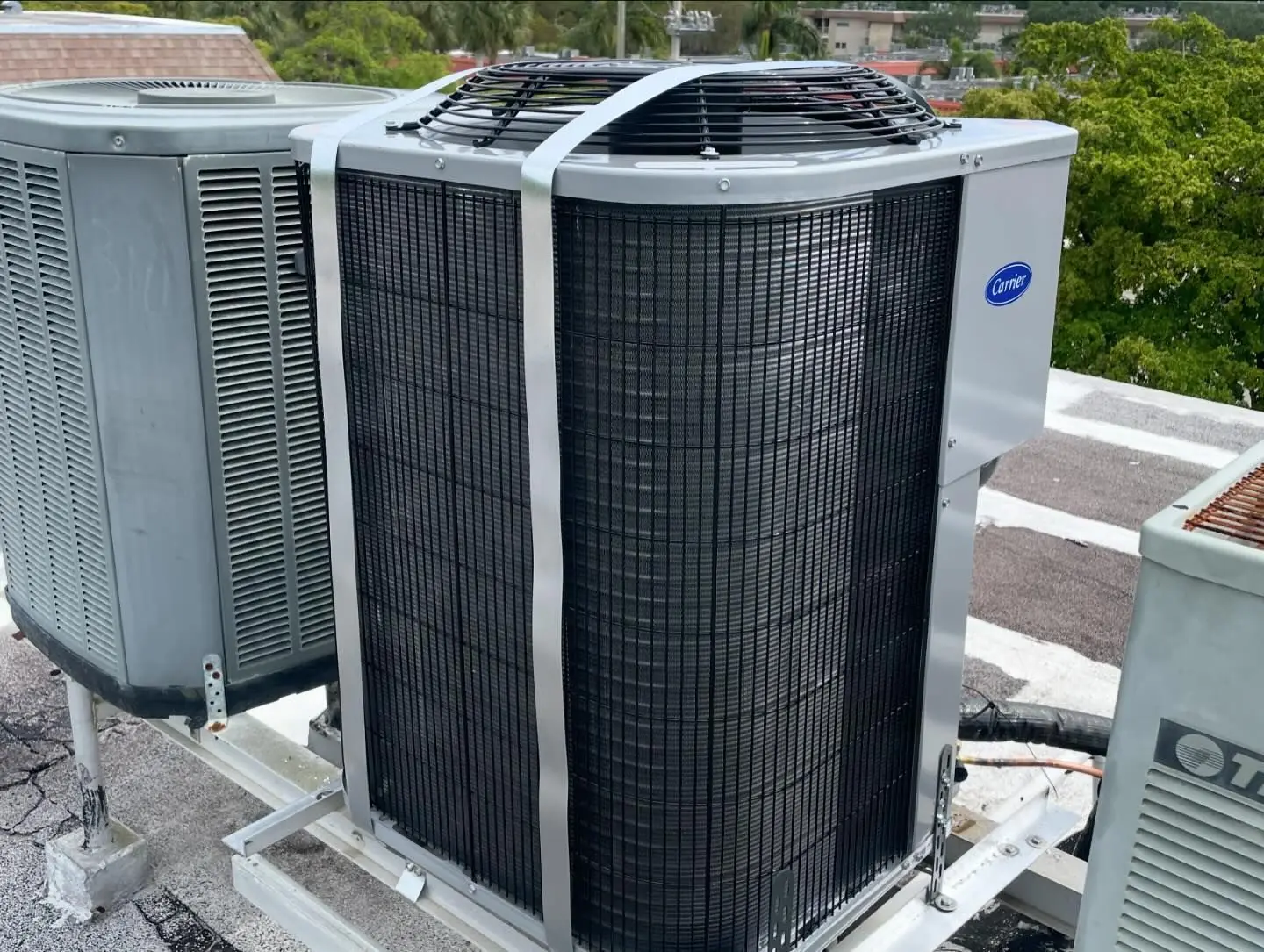
Outdoor units in condo buildings are often on the roof, on a catwalk, or on a balcony or ground pad some distance from the unit they serve.
- Hurricane-zone anchoring. Broward County is in the Florida Building Code's High-Velocity Hurricane Zone, and outdoor equipment has to be fastened to rated stands, curbs or slabs that resist the code's wind pressures. See AC permits in Broward.
- Roof paperwork. Broward's permit rules require attachment details for roof-mounted equipment that meet the High-Velocity Hurricane Zone requirements, along with a roof-top mounted equipment affidavit.
- Reroofing. If your building is reroofed, existing rooftop equipment that's moved and doesn't meet current code has to be brought up to it. That's worth knowing if a roof project and an AC replacement are both on the horizon.
- Getting it up there. Rooftop replacements can involve lifting equipment onto the roof, which takes planning with the association and building management.
Timing: plan before it fails
A condo replacement has more moving parts than a house, with approvals, access and sometimes a lift to arrange. All of that is harder when the system has just died in August. If your system is old, needs frequent repairs or leaks refrigerant, it helps to know what your building requires before you need it, even if repair is still the sensible call for now. See repair or replace?.
If a system does fail and has to be replaced as an emergency, Broward's permit rules allow the work to proceed with the permit application submitted the next working business day. Your association's rules still apply.
Questions to ask before you sign
- Has the association approved the replacement, and does it need anything else, such as insurance certificates, access times or elevator reservations?
- Will the new air handler fit the closet and leave service access to the filter, coil and drain?
- How is overflow handled (secondary pan, overflow drain or float switch), and where does the drain go?
- Are the indoor and outdoor units a matched, certified pair? Will the line set be reused, and has it been checked?
- Who files the permit, and how is the outdoor unit being anchored?
We're glad to walk through any of these on site before you decide. See AC replacement and installation.
A condo replacement, step by step
The order that avoids the most common surprises. Your building's rules may add steps.
Read the documents
Check the declaration and the association's rules for who owns the equipment, where it may sit, and what approval a replacement needs.
Survey the installation
Measure the closet and door, look at the drain route and the condenser location, and note how equipment gets in and out of the building.
Size and match the system
Choose indoor and outdoor equipment as a certified pair, sized to the unit's actual load.
Association approval
Submit what the association asks for. Some city change-out checklists ask for an association approval letter where one is required.
City permit
The contractor files the mechanical permit with the city's building department, including tie-down details for outdoor equipment.
Install day
Scheduled around the building's rules for elevators, roof access and work hours, with shared hallways protected.
Inspection and paperwork
The city inspects the finished work. Keep the permit, the equipment details and the startup readings with your unit records.
About this guide
- Written by
- Service Shield Air Conditioning
- Published
- Oct 2026
- Last updated
- Oct 2026
Sources
- Florida Statutes §718.113: Maintenance; limitation upon improvement (condominiums)
- Broward County Amendments to the Florida Building Code, Chapter 1 §105 (permits) (Municode)
- Broward County Amendments to the Florida Building Code, Chapter 1 §107 (submittal documents) (Municode)
- Broward County Amendments to the Florida Building Code, Chapter 1 §102.8 (existing rooftop equipment) (Municode)
- Florida Building Code, Mechanical 2023: §301.15 wind resistance and §307.2.3 auxiliary condensate protection (UpCodes)
- Florida Building Code, Energy Conservation 2023: R501.7 replacement equipment, matched systems (UpCodes)
- City of Wilton Manors: A/C change-out checklist
- EPA: Technology Transitions HFC Restrictions by Sector
- EPA: SNAP Rule 23 final rule, 86 FR 24444 (A2L refrigerants in residential AC)
- Trane: What Is an Air Handler?
Condo questions
Can I replace just the air handler in my condo?
Sometimes. The indoor and outdoor units have to be a certified matched pair, so an air handler on its own only makes sense when the outdoor unit is recent and compatible with it. With the refrigerant transition, older systems often need both halves replaced together. A technician can check the outdoor unit's model and refrigerant and tell you which applies.
Do I need my condo association's approval to replace my AC?
Often, yes, so check before you schedule. Florida law limits alterations to a condominium's common elements to what the declaration allows, and equipment on roofs, catwalks or in shared spaces can fall under those rules. Your declaration, rules or property manager will tell you what approval, paperwork and access arrangements a replacement needs.
Related services and problems
Planning a condo replacement?
An estimate for a condo starts with the closet, the drain route, where the condenser lives and what your association needs to see.
The on-site evaluation for a new system is free.
Florida license CAC1821225